RHAYNE
VERMETTE
UPCOMING SCREENINGS.
Artifict Film Festival, Calgary Alberta – April 3
info: https://artifactfilmfestival.
Honk Kong International Film Festival, China – April 4 & 7
info: https://www.hkiff.org.
Massachusetts Multicultural Film Festival, Massachussetts – April 15
info: https://websites.umass.edu/
PAST SCREENINGS.
Victoria Film Festival – February 11
COMING FALL 2025.
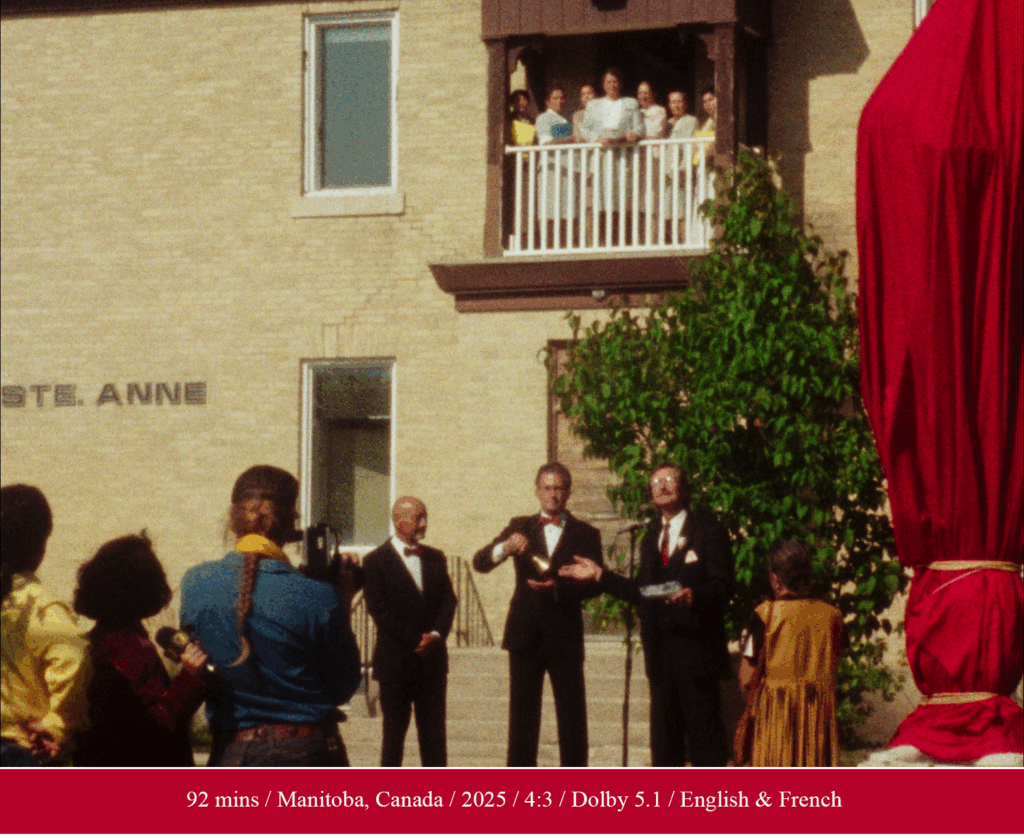
In the beginning was sound. It broke an infinite nothing, hissing, shaking, and rattling out into all directions. Meanwhile, in Manitoba, a canon blasts as a new statue is unveiled, and the following day, the sun does not rise. Worldwide, people huddle around the warm glow of their television sets eagerly awaiting the uprising of a new sun, but in the Red River Valley, mysterious events unfold, weaving together the lives of a sculptor, a security guard, and an intrepid civil servant.
Shot in saturated 16mm film on broken Bolex cameras, Levers mixes in-camera fx with a delicate eye for beauty, portraying an exploration of communal mourning through a potent mixture of the rarity of fantasy and the idleness of the everyday.
Levers is the second feature film from Exovedate Productions LTD. “Often imitated, never duplicated.”
Thank you to our funders: The Indigenous Screen Office, Canada Council for the Arts, Manitoba Arts Council, Winnipeg Arts Council and Sundance’s Merata Mita Fellowship.
Please contact [email protected] for screeners or more information.
ABOUT THE DIRECTOR…
Primarily self-taught, Rhayne Vermette’s work emphasizes an interference of image through collage, photography and analog filmmaking. Themes of place, time and rhythm are expressed through opulent layers of fiction, animation, reenactments and divine interruption. Deeply rooted in Manitoba, Rhayne frequently enlists the talent of her loved ones and community in the making of her films. Ste. Anne (2021), Rhayne’s first feature narrative featuring some of her own family members from Ste. Anne, Manitoba, received critical acclaim and accrued a number of accolades including TIFF’s Amplify Voices Award for Best Canadian Feature Film. In 2024, Rhayne was shortlisted for the Sobey Art Award, Canada’s preeminent prize for contemporary visual artists. Rhéanne (Rhayne) Vermette was born to parents Jacqueline Deroche and Roger Vermette in Notre Dame de Lourdes, Manitoba. Roger Vermette was born in St. Boniface and raised in Ste. Anne, Manitoba, a community historically settled by Métis and FrenchCanadians. His father, Joseph Vermette, was born in St. Norbert, Manitoba and died in Richer, Manitoba. His father before him, Jean Vermette, was also born in St. Norbert, a significant Red River Métis community, and passed in Richer, Manitoba.